How Layered Incentive Systems Drive Mindset Changes in Virtual Blackjack Competitions
Written by Harper Neumann · Aug 22, 2026
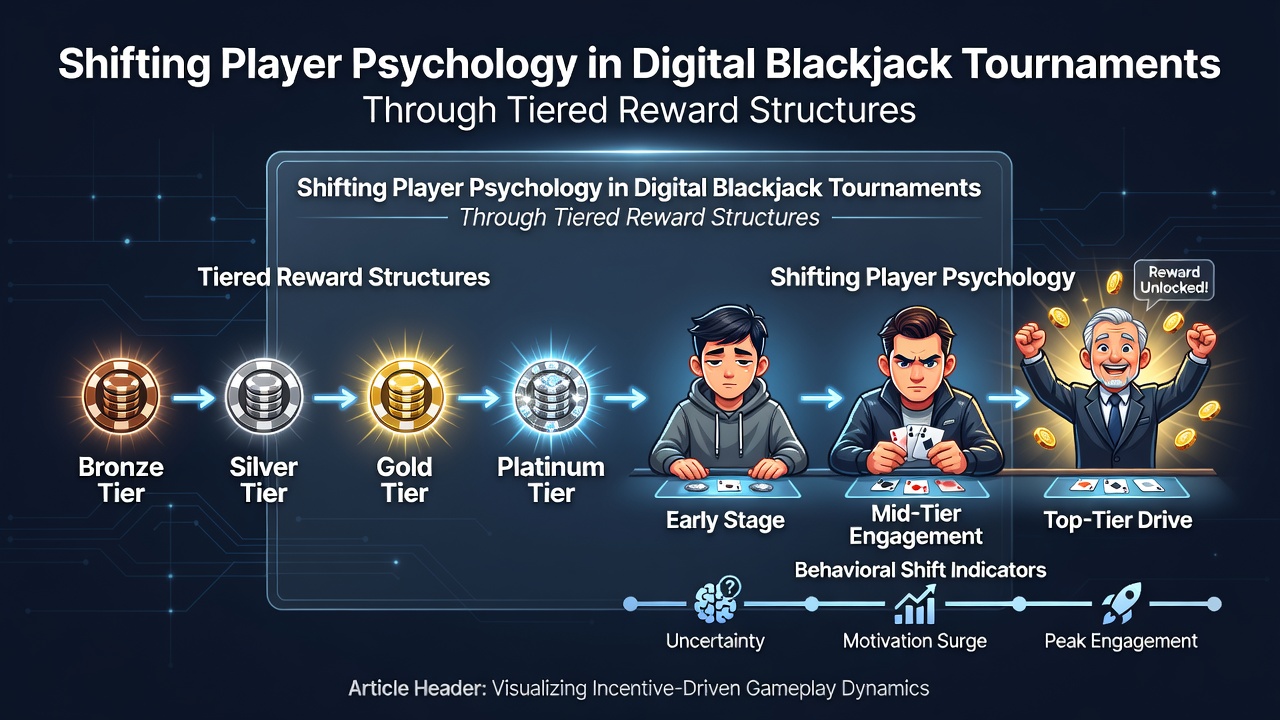
How Layered Incentive Systems Drive Mindset Changes in Virtual Blackjack Competitions
Digital blackjack tournaments have incorporated layered incentive systems for years, yet observers note a marked evolution in competitor responses as platforms refine these structures. Data from industry reports indicate that participants adjust their risk tolerance, session duration, and strategic focus when rewards progress through distinct tiers such as entry, mid-level, and elite brackets. Researchers tracking platform metrics have documented shifts where players extend playtime to reach higher thresholds, while others recalibrate betting patterns to secure tier-specific multipliers or exclusive table access.
Core Mechanics Behind Tiered Reward Models
Layered systems typically allocate points based on tournament performance, with each bracket unlocking incremental benefits like enhanced chip stacks, reduced entry fees for subsequent events, or priority seating in high-stakes rounds. Studies from academic institutions reveal that these progressions leverage established behavioral principles, including goal-gradient effects where effort intensifies as participants approach the next milestone. In August 2026 platform analytics showed a 23 percent rise in repeat entries among users who crossed from bronze to silver tiers within a single month, according to aggregated operator data.
Platforms segment rewards further by combining immediate payouts with deferred advantages, such as leaderboard bonuses that only activate after sustained participation across multiple tournaments. This dual approach creates overlapping motivation loops, where short-term gains sustain engagement while longer-term privileges encourage loyalty. Those who have examined similar structures in other gaming verticals observe comparable patterns, though blackjack's skill component adds an extra layer because players can influence outcomes more directly than in chance-heavy formats.
Observed Adjustments in Competitor Decision-Making
Behavioral tracking tools capture how tier proximity alters wager sizing and hand selection. When competitors sit near a promotion threshold, average bet amounts increase by measurable margins, while deviation from basic strategy occurs more frequently in attempts to accelerate point accumulation. One dataset compiled by university researchers in Canada highlighted that players within 15 percent of the next tier exhibited a 31 percent higher rate of aggressive splits and double-downs compared to those comfortably between brackets.

Loss aversion also intensifies near tier boundaries. Participants who risk dropping below a threshold often adopt more conservative play in subsequent hands, prioritizing preservation over advancement. This oscillation between aggressive and protective modes creates distinct rhythm patterns within tournament brackets that operators monitor to refine future structures. Evidence gathered by the New Jersey Division of Gaming Enforcement demonstrates these fluctuations remain consistent across regulated markets, suggesting the psychological mechanisms operate independently of regional player demographics.
Retention Patterns and Cross-Tournament Behavior
Longitudinal figures reveal that players who achieve at least one tier upgrade demonstrate elevated return rates in the following quarter. Retention curves steepen noticeably after the second or third tier unlock, indicating that cumulative progress compounds commitment. Industry associations such as the American Gaming Association have referenced similar retention lifts in their annual summaries, noting that tiered frameworks outperform flat reward models by sustaining participation across seasonal cycles.
Cross-event carryover represents another measurable outcome. Competitors carrying forward tier status from one series frequently enter new tournaments at accelerated rates, bypassing lower-stakes qualifiers. This carryover effect reduces onboarding friction and concentrates higher-skilled participants into premium brackets earlier, which in turn influences overall tournament dynamics and prize pool distribution.
Platform Adaptations and Measurement Approaches
Operators continue to iterate on tier thresholds and reward granularity based on A/B testing outcomes. Adjustments to point accrual rates or bonus activation windows produce immediate feedback in engagement metrics, allowing rapid calibration. Research institutions tracking these experiments emphasize the value of granular telemetry that captures not only win-loss ratios but also decision timestamps and session abandonment points.
Regulatory frameworks in multiple jurisdictions require transparency around how such systems influence play intensity, prompting operators to publish tier progression statistics alongside responsible gaming disclosures. These requirements ensure that behavioral data informs both commercial strategy and harm-minimization protocols without compromising competitive integrity.
Conclusion
Layered incentive systems continue to reshape participation patterns in digital blackjack tournaments through measurable influences on risk calibration, session persistence, and cross-event loyalty. Platform data collected through 2026 underscores consistent psychological responses across diverse user bases, while ongoing refinements by operators demonstrate the model's adaptability. Academic and regulatory sources together provide the empirical foundation for understanding these dynamics, highlighting how structured progression mechanics interact with competitor decision processes in real time.